
The ostensible purpose of the ongoing habitat restoration in Barnegat Light is to help the Island’s unique, native nesting bird species, such as terns, skimmers, plovers, and oystercatchers, and that’s true. However, since the project simply restores the habitat to its original, natural glory, the area is a boon to almost any bird that stumbles upon this gem of the inlet.
Common birds like mallards, robins, doves, and blackbirds flock to the area for water, forage, peace, and safety. Egrets and herons are in heaven there. Exotic visitors like Snowy Owls now have the large open sandy areas they need and are looking for when far from home.
And even our gulls, who, of all birds, are the best adapted to living under people’s feet and probably need that space the least, appreciate the quiet place to go in times of need.
The south side of the area’s big pond is called “The Hospice” because, sadly, it is a popular place where sick and wounded gulls go to die in peace, free from children chasing them or the cruelest among us throwing clamshells at them. It is common to find a gull hopelessly tangled and skewered with fishing lures hiding in some vegetation, taking its last breaths, or a gull with an unhealed, broken wing strolling the pond shore, hoping for a few final meals. During significant bird flu outbreaks, piles of dead gulls were found along the Hospice.

I was following a coyote through Barnegat Light when it led me straight to the nest of oystercatcher A65. I was shocked to discover the oystercatcher pair in a panic, not because of the coyote, but because of a young herring gull lying in the sand not 20 feet away from their nest!
Since neither the frantic oystercatchers nor I were enough to make the gull move, I approached it to attempt to bump it. Once it moved, I saw the horrific shape the poor thing was in. Its shoulder was raised unaturally above its head in a manner which looked gruesome, its foot was dead and dragging limpishly behind it, and this broken wing appeared to be tethered to this dead foot.

I left the area quickly, concerned that I could easily cause this unstable gull to stumble into the oystercatchers’ nest. I noted in NestStory that anyone visiting should bring a towel or something big enough to catch the gull. Even if the gull couldn’t be helped, it at least could be moved away from the fragile nest.
Sometimes, these poor souls can be helped; sometimes, they can’t. The Hospice is often a sad sight, but it is also a comfort and a reminder of just how important it is for animals to have some place to go that is just for them.

The next day, I found the gull again; this time, far from any nests, sitting peacefully and unreachable, deep in the big pond. Seeing the poor thing again was saddening, but it was also encouraging to witness its resilience. It had reached the Hospice, where it could find food, water, and peace, away from the oystercatchers.
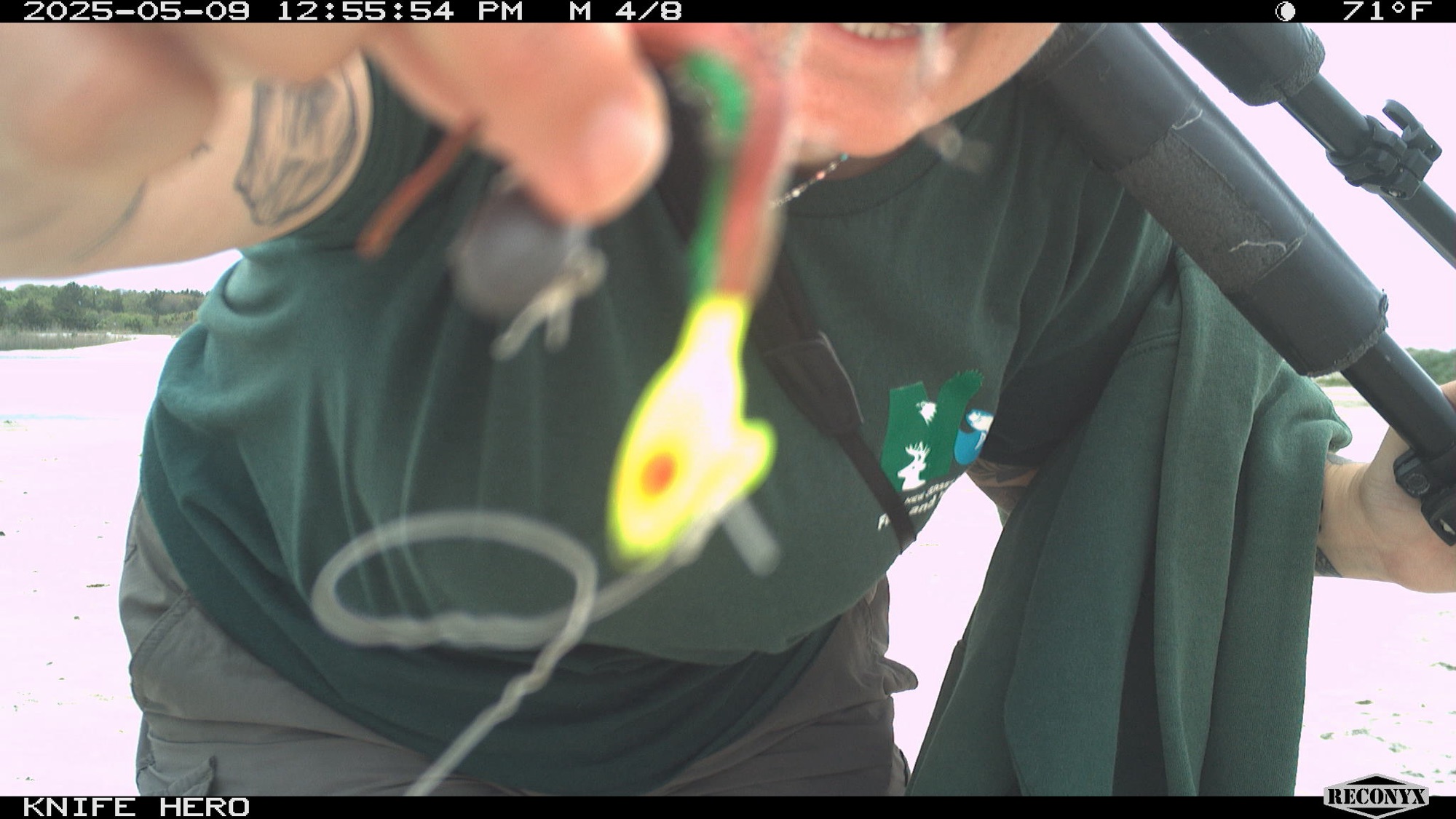
Then the next day, at work, one of the Little Egg Foundation’s predator cams in the park suddenly started sounding an alarm. The alarm was unusual, as the cameras primarily detect coyotes at night. Checking the cameras, I found this image.

This photo could only mean one thing: Brianna from NJ Fish & Wildlife read my note in NestStory, remembered it, came prepared, and somehow managed to find, catch, untangle, and surgically remove a bunch of rusty hooks from this poor bird. And she knew the fastest way to get my attention and share this would be to pretend to be a coyote walking around in broad daylight! It was the ultimate humble brag to boot.
So how did she do this without any help from anybody, all as a side quest on an already hectic mission? Luckily, she recorded a video of it.

Unluckily, she left the camera on “Photo” instead of “Video” so that will remain her secret, I guess. But she did manage to get this clip of our little friend hobbling away free for the first time:
Later that night, I mostly went to the park to see this gull. I found the gull right around where she had left it. And as I approached, I saw it do something I never thought it would do again.

Fly!

A funny footnote to this story: You may have missed the camera’s name in the photo Bri triggered on the predator camera. It’s “Knife Hero,” a ridiculous name that coincidentally and perfectly captured the heroic act that had just unfolded.
Brianna, you truly are the Knife Hero!
Remember this story whenever you hear “New Jersey Fish & Wildlife” and “The Barnegat Light Habitat Restoration Project.”
The most remarkable thing about kindness, clarity, and compassion is how they are each best measured in our lives’ most minor, seemingly insignificant details. Admittedly, Bri is the best of the best, but her spirit, skill, expertise, and compassion are the heart of NJ Fish & Wildlife, its mission, and the Barnegat Light habitat restoration. The fact that this was just some hapless gull and not some critically endangered animal makes the point of what’s really going on out there that much clearer.
And now that I’m sufficiently inspired by Bri to celebrate kindness, I’ll start by calling my mom.
Happy Mother’s Day!


What a great story with a happy ending! Thank you for sharing.
Sent from the all new AOL app for iOS
Yay, Bri!!
what an amazing story, somewhat sad, of the reality of nature. We humans have injected ourselves in a negative way sometimes and nature does pay the price. Brianna is a real hero, her compassion illustrated is unmatched. She’s my hero, and also my daughter. I love you and thank you for being the Knife Hero ❤️