


J23 and his unbanded mate have hatched the second nest of the season in Plover Park. Well, perhaps not entirely, as you’re about to see.
But this is a big win, as this nest was the first to receive the flasher treatment from the new gear generously donated by all of you.
The nest was a high risk/high reward scenario; it put them in a great territory for raising the chicks, but the nest itself was right in a common predator path where we’ve lost multiple nests in the past.
And so it was incredibly encouraging to see, first hand, how your flashers successfully repelled at least one coyote whose tracks, heading straight for it, suddenly stopped and did a sharp turn about 80 feet from the nest (and then went on to eat two others without them, unfortunately)! It’s some really exciting evidence that flashers can make a difference.


The first chick hatched in the afternoon and the other two still weren’t hatched by sundown. I went to bed a little anxious, obviously, and woke up unnaturally early the next morning. As I’m sure you can guess, the first thing I did that morning was check their camera.

It was just before 6AM and I could see the chick in the camera’s live view. Great. Checking the eggs, I could see an egg was missing. Greater! Hoping the second chick was also out, and just off camera, I quickly went back through the photos taken overnight. But I couldn’t find any evidence of a second egg hatching. Just an abrupt change where there were two eggs, then suddenly, just one.
Then I saw this one from around 2AM:

Infrared photography can produce a lot of deceiving anomalies. But that sure does look like an egg stuck to J23 as he runs off. What do you think?

I’ve seen that before with chicks getting stuck under a wing… but an egg? How does an oystercatcher carry an egg away from the nest? Could it be stuck to J23 somehow?
For a split-second I considered reaching out to the dream team of Emily, Kashi, Michelle, and Todd to ask them weigh in on this strange photo. But then decided not to start their day off as poorly as mine was starting. And besides; no matter what anyone thought they saw in that photo, there was only one way to actually know for sure.
So of course I ran over there! And, sho’nuff…
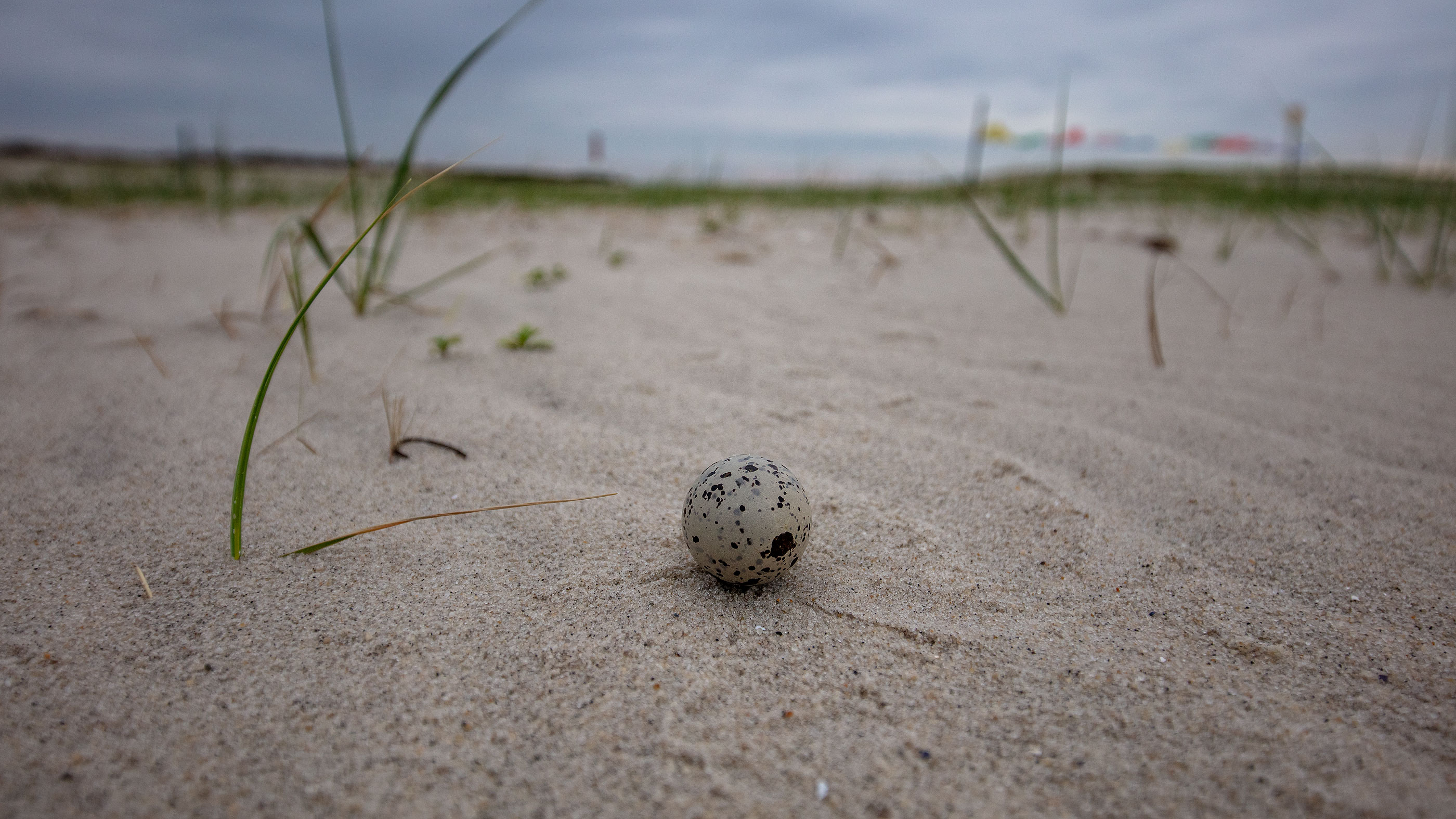

The great Kathy Clark once famously said, “If you’re not looking, you’re not going to see it.” Ain’t that the truth. I can’t believe we caught that on camera, and I wasn’t sure, at 5:30 that morning, if I wanted to. Ignorance is bliss!
Every once in a while, an egg goes missing mysteriously at a nest (called a clutch reduction). Sometimes there is no track evidence to suggest predation, or wind and terrain conditions that would support a theory of the egg rolling out of the nest.
I don’t think I’ve ever thought, or heard anyone suggest, “maybe it got stuck to one of the parents!”
So the only remaining question was, “what to do about it?”
I wasn’t sure. I’m all for interfering with nesting when we are actively trying to fix something that our species broke. I fully support Plover Park because it restored the habitat that was destroyed when the inlet jetty was built. I fully support exclosing nests and managing predators because we are mostly dealing with animals who followed us humans here to the Island, and who wouldn’t stay, and couldn’t survive here, without our trash and handouts.
But an egg sticking to, or getting carried off by, an adult? Well, that must just be part of the life of the ridiculously clumsy and tragically whimsical oystercatcher species. Maybe there is even a reason for it. Who am I to say?
But it was way too early for such elegant musings and internal, philosophical debates. I hadn’t even had my coffee yet.
So I checked in with Kashi & Emily, and, of course, I put it back!

The two remaining eggs never hatched. J23 & mate made the smart choice, and have moved on. They are now out there in the wilderness of Plover Park raising their one-and-only chick of 2026. Boy, is that baby going to get spoiled! They really are spectacular parents. Except for, maybe, when they let their own eggs get stuck to them.


Say something kind