Imagine you check your 401k and discover that your $100,000 balance has suddenly skyrocketed to $500,000—a fivefold, 400% increase. You call the brokerage and ask what gives. The advisor explains that your account had become slightly overgrown with someone else’s under-performing investments. So they trimmed it back a little to give your money room to grow again, restoring the natural balance of your portfolio. It’s legit. That money is yours to enjoy. Stonks!

That’s exactly what’s happening right now in Barnegat Light State Park. Thanks to the stimulus provided by the ongoing habitat restoration project, native birds are returning to Barnegat Light to get down to business and breed in historic numbers.
It’s a rampaging bull market in beach-nesting birds.
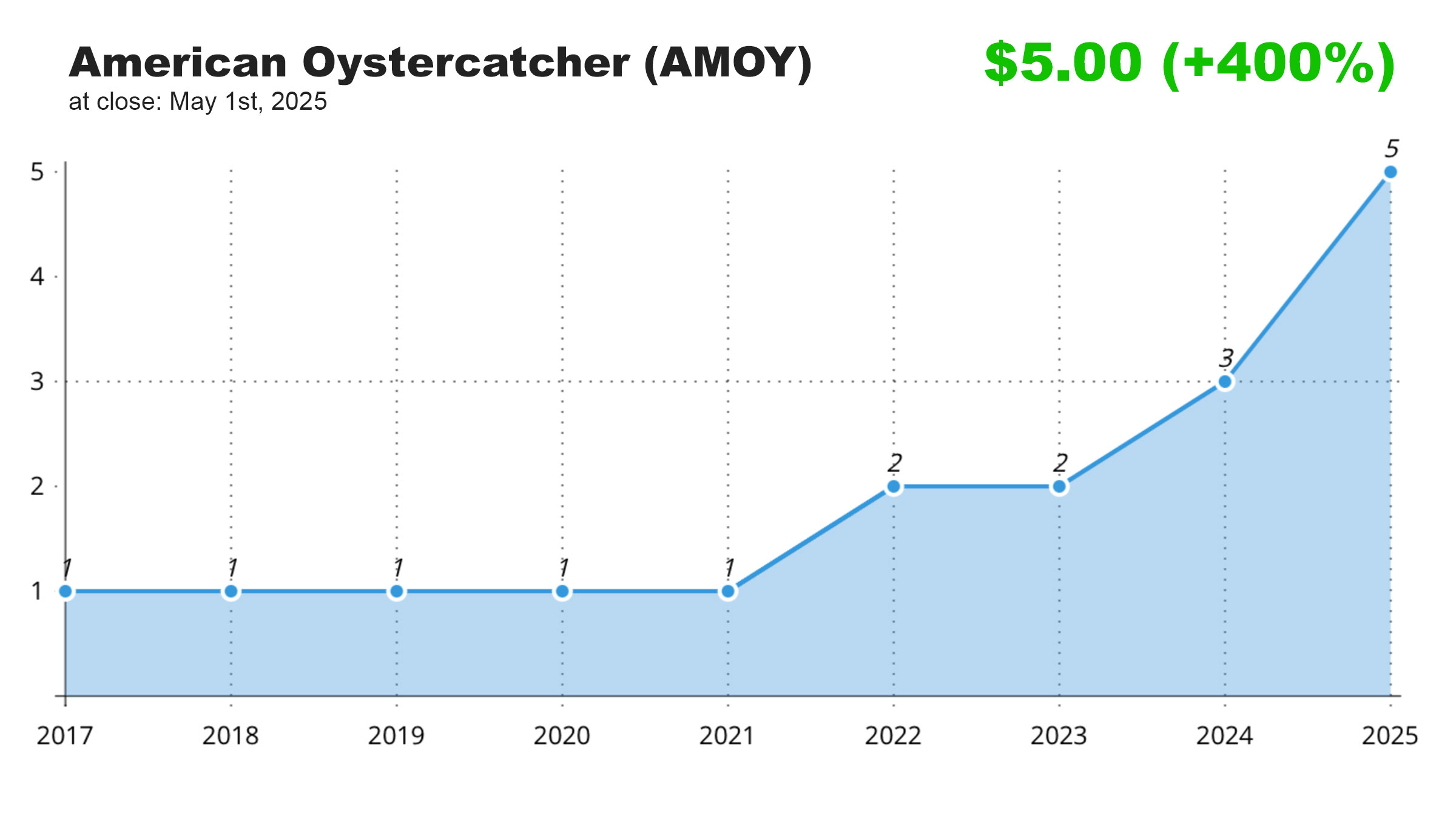
And no sector is hotter right now than the American Oystercatcher, having risen over 400% since this new market opened.

This rally in AMOY is especially exciting since the Park’s single Oystercatcher pair suffered there for years, on the verge of utter bankruptcy, their stock languishing.
People watched in horror as Barnegat Light’s celebrity local bird, “T2,” laid nest after nest, year after year, always losing it to human disturbance or predation by non-native species who were there to eat visitor trash and anglers’ improperly discarded waste. T2 had fans and cheerleaders all through the decline, but they were dead money.

Sadly, T2 passed away just before the habitat was restored and this bull market began in earnest.
He was soon replaced by new local favorites J22 and J23 when the restoration area opened and then joined by a new, unbanded pair named “The Hilltopers.” These two pairs doubled the pair count in a single season, and have been thriving there for the last few years, which was a massive success in its own right.
But suddenly, in 2025, we’ve doubled again and gone beyond that. The chart is going parabolic!

As of last night, there are not only 5 pairs of Oystercatchers using the habitat, but all five have laid nests. That’s 12 eggs and counting, and the chance for as many as 12 babies this season. You have to go back decades in Island history to find numbers like that. It’s astonishing.


Were you on the sidelines when we hit bottom? Is it too late to invest in AMOY or the BNB500 Index?
Probably not. This trend has momentum. But when a chart goes parabolic like this, it defies gravity and usually signals a correction is coming. Fortunately, corrections are natural. Nests will be laid, lost, and relaid. Chicks will hatch, chicks will perish. But more will survive, and some will return to breed themselves. It’s not perfection, but growth that matters.
Five breeding pairs may not sound like a lot, but it’s five times better than one. Barnegat Light is a tiny little corner of the world. Imagine if every habitat could increase its wealth x5. This would be a very prosperous world, indeed.
It’s clearly a bull market for beach nesters. Thanks to a healthy economic environment created by the ongoing habitat restoration, these birds can finally get down to business and grow.
I certainly wouldn’t bet against them.

Stonks.


wonderful!
Such uplifting news. Very Much needed. Thank you!
Good news!
Hooray for the bird bull market and the man with the pen and camera reporting it all!